Introduction
If you sell products or services across state lines, sales tax registration is no longer optional. Economic nexus rules mean many ecommerce businesses, Amazon sellers, Shopify merchants, SaaS companies, and even small business owners must register once they hit specific sales or transaction thresholds.
Sales tax registration gives you the legal authority to collect and remit sales tax in a state. Without it, you risk penalties, interest, and personal liability. The process differs by state, yet the core steps stay consistent. You identify where you have nexus, gather documents, and apply online or through the Streamlined Sales Tax system.
This guide walks you through the full sales tax registration process. You will learn when registration becomes required, how to handle multi-state filings, common pitfalls, and practical steps that keep your business compliant. Whether you manage finance for a growing Shopify store or oversee compliance for a SaaS platform, clear knowledge of sales tax registration protects your bottom line and reduces audit risk.
Key Takeaways
- Sales tax registration is required in every state where you establish physical or economic nexus.
- Most states offer free or low-cost online registration; fees rarely exceed $100.
- The Streamlined Sales Tax Registration System lets you register in more than 20 member states with one application.
- Registration usually takes days to a few weeks; collection often begins immediately or shortly after approval.
- Missing registration deadlines can trigger back taxes, penalties, and interest.
- Marketplace facilitators may collect tax for you, but direct sales still require your own registration in many states.
- Ongoing monitoring of sales thresholds prevents surprise obligations.
What Is Sales Tax Registration?
Sales tax registration is the formal process of obtaining a permit, license, or certificate from a state tax authority that authorizes your business to collect and remit sales and use tax. States call it by different names: seller’s permit in California, sales tax permit in Texas, Certificate of Authority in New York, or Transaction Privilege Tax license in Arizona.
Regardless of the label, the document serves the same purpose. It places you on the state’s radar so you can collect tax from customers and file returns on time. You must complete sales tax registration before you start collecting tax in most jurisdictions. Collecting without a valid permit can create problems for both you and your customers.
Think of it like a driver’s license for tax collection. Without it, you cannot legally operate on that state’s “road.” Five states (Alaska, Delaware, Montana, New Hampshire, and Oregon) have no statewide sales tax, though Alaska has local taxes that may still require registration through the Alaska Remote Seller Sales Tax Commission.
Why Does Sales Tax Registration Matter for Ecommerce and Multi-State Sellers?
Before the 2018 South Dakota v. Wayfair decision, only physical presence created nexus. Today economic activity alone can trigger the obligation. Once you cross a state’s threshold (often $100,000 in sales or 200 transactions), you generally must register.
Failing to complete sales tax registration exposes your business to assessments for uncollected tax, plus penalties and interest that can stretch back several years. States increasingly use data matching and marketplace reports to find non-compliant sellers. For Amazon FBA sellers, inventory stored in fulfillment centers can create physical nexus in multiple states even before economic thresholds are met.
Proper registration also lets you issue valid exemption certificates to suppliers and protect resale purchases. Without it, you may pay unnecessary tax on inventory. For CFOs and finance teams, timely sales tax registration keeps financial statements accurate and reduces contingent liabilities.
When Should You Register for Sales Tax?
You should register as soon as you establish nexus. Physical nexus arises from offices, employees, warehouses, or inventory (including Amazon FBA stock). Economic nexus arises when sales or transactions exceed state thresholds.
Thresholds vary. Many states use $100,000 in gross or retail sales. California and Texas sit at $500,000. New York requires both $500,000 and 100 transactions. Some states measure the prior calendar year; others look at the current year or a rolling 12-month period. Several states have eliminated the transaction threshold to simplify rules.
Registration timing also differs. Some states require action on the next sale after the threshold is crossed. Others give 30, 60, or even 90 days. Waiting until year-end is risky. Monitor sales monthly and register proactively once you approach 80 percent of a threshold. For detailed current thresholds, review the economic nexus guide on our site.
Marketplace sales often count toward the threshold even when the facilitator collects the tax. Direct sales remain your responsibility.
How Does the Sales Tax Registration Process Work?
The process follows a similar path in most states, though details differ.
- Confirm nexus in the target state.
- Gather required information: EIN or SSN, legal business name, DBA, address, entity type, ownership details, NAICS code, description of products or services, estimated sales, and banking information for electronic payments.
- Locate the official state Department of Revenue or equivalent portal. Search “[state] sales tax registration” and use only .gov sites.
- Complete the online application. Most states prefer this method and process applications faster.
- Pay any fee (many are free).
- Receive your permit number, often within days to a few weeks.
- Begin collecting tax on the effective date and set up filing frequency (monthly, quarterly, or annually based on volume).
Paper applications remain available in some states but take longer. Security deposits appear in a few jurisdictions for new or higher-risk applicants.
What Is the Streamlined Sales Tax Registration System?
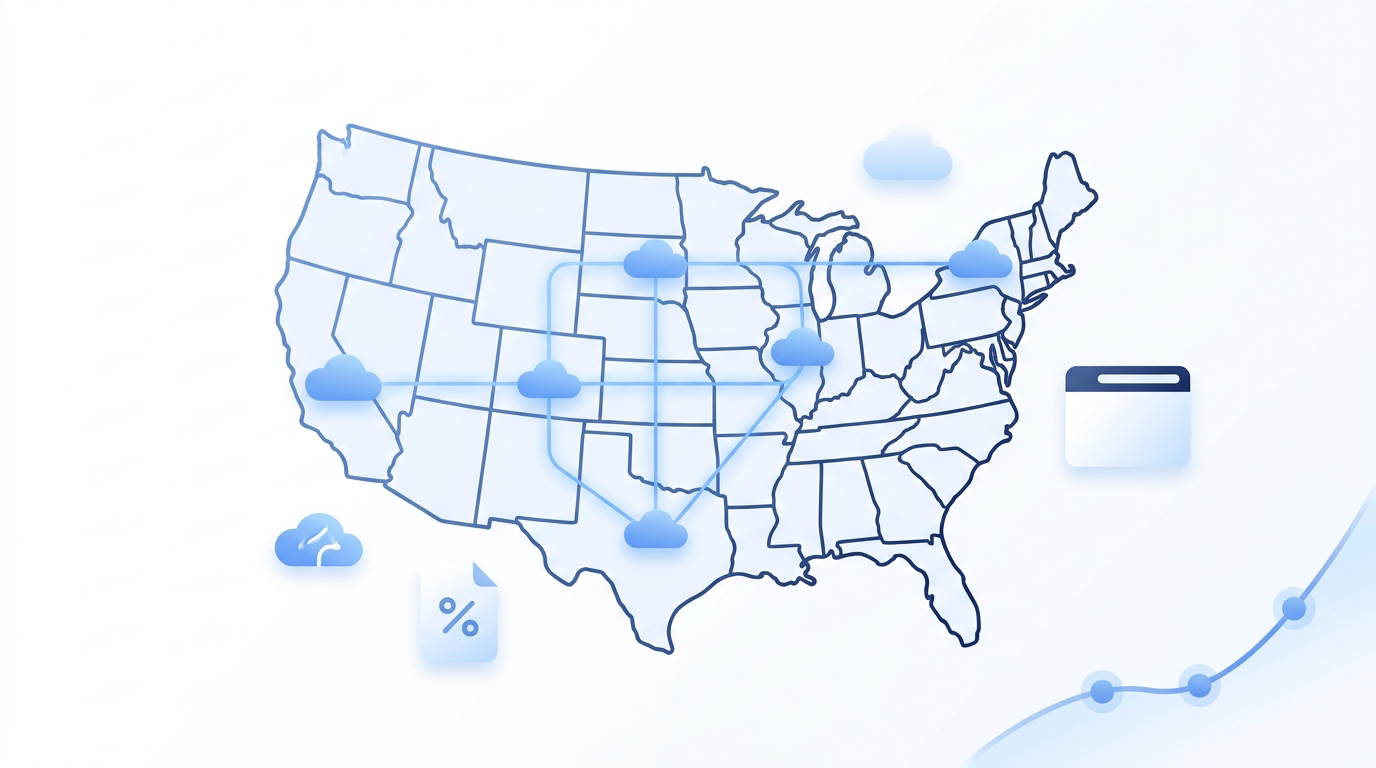
The Streamlined Sales Tax Registration System (SSTRS) offers a single free online application that registers you in all full-member Streamlined states. As of recent data, more than 20 full members participate, including Arkansas, Georgia, Indiana, Iowa, Kansas, Kentucky, Michigan, Minnesota, Nebraska, Nevada, New Jersey, North Carolina, North Dakota, Ohio, Oklahoma, Rhode Island, South Dakota, Utah, Vermont, Washington, West Virginia, Wisconsin, and Wyoming. Tennessee is an associate member.
You choose the states, submit one form, and each state issues its own permit. You still file returns and remit tax directly to each state (or through a Certified Service Provider). The system does not cover non-member states such as California, Texas, Florida, or New York. Use SSTRS for member states and register individually elsewhere.
This approach dramatically reduces the administrative burden of multi-state sales tax registration.
Sales Tax Registration Requirements by State Type
States fall into three broad groups for practical purposes.
- No statewide sales tax: Alaska (local only), Delaware, Montana, New Hampshire, Oregon.
- Streamlined member states: Use the single SSTRS application.
- Non-member high-volume states: Register directly. California (CDTFA), Texas (Comptroller), Florida (Department of Revenue), New York (Department of Taxation and Finance), and others each maintain their own portals.
Fees are usually $0. Exceptions include Arizona ($12 plus local fees), Arkansas ($50 for some permits), Connecticut ($100), Hawaii ($20), and a few others. Processing times range from immediate to several weeks. Always verify current details on the official state site because rules and portals change.
Step-by-Step Guide: How to Register for Sales Tax in Multiple States
- Start with a nexus study. List every state where physical presence or economic thresholds apply. Prioritize high-risk or high-volume states.
- Next, decide on the registration path. For Streamlined states, complete the SSTRS application first. For others, tackle one state at a time or engage a specialist.
- Prepare a master information packet so you avoid re-entering the same data repeatedly. Track application dates, confirmation numbers, and effective dates in a spreadsheet.
- After approval, configure your shopping cart or ERP to collect the correct rates. Set calendar reminders for return due dates. Many states require zero returns even in periods with no sales.
- If past exposure exists, consider voluntary disclosure programs before registering. These programs often limit look-back periods and reduce penalties.
Comparison Table: Registration Options and Key Features
| Option | Number of States | Cost | Processing Time | Best For | Limitations |
|---|
| Individual State Portals | 1 per application | $0–$100 | Immediate to 4 weeks | Non-SST states or single-state needs | Time-consuming for many states |
| Streamlined Sales Tax (SSTRS) | 20+ member states | Free (state fees may apply) | Usually 15 business days | Multi-state sellers in member states | Does not cover CA, TX, FL, NY, etc. |
| Professional Service | Any combination | Varies by provider | 1–3 weeks typical | Busy teams or complex histories | Cost of service |
This table helps you choose the most efficient path for your sales tax registration needs.
Examples and Case Studies
Consider an Amazon FBA seller based in Oregon (no state sales tax) who stores inventory in California, Texas, and Pennsylvania warehouses. Physical nexus exists in those three states immediately. Economic thresholds may also apply elsewhere based on sales volume. The seller must complete sales tax registration in each nexus state, even though Amazon collects tax on marketplace orders. Direct website sales require separate collection.
A SaaS company selling subscriptions nationwide crosses $100,000 in Illinois and $500,000 in California. Registration becomes mandatory in both. Because taxability of digital goods varies, the company pairs registration with taxability research.
A Shopify merchant with $80,000 in Florida sales waits too long. When the threshold is crossed mid-year, the state assesses tax on subsequent sales plus penalties. Early monitoring would have prevented the issue.
These scenarios show why proactive sales tax registration protects cash flow and reputation.
Common Mistakes in the Sales Tax Registration Process
Many businesses register too late and face assessments for prior periods. Others register in states without nexus and create unnecessary filing obligations.
Using unofficial third-party sites can lead to incomplete or incorrect applications. Failing to update addresses or ownership changes after registration causes notices. Ignoring marketplace facilitator rules leads to double-counting or under-counting thresholds.
Some sellers collect tax before receiving the permit. Others forget that zero returns are still required. Security deposits and bond requirements surprise unprepared applicants in certain states.
Avoid these errors by treating sales tax registration as an ongoing compliance function rather than a one-time task.
Actionable Compliance Checklist
- Conduct a full nexus analysis covering physical presence, economic thresholds, and marketplace activity.
- List all states requiring registration and note effective dates.
- Gather EIN, ownership details, product descriptions, and banking info.
- Register via SSTRS for member states.
- Complete individual applications for remaining states.
- Record permit numbers and filing frequencies.
- Configure tax collection in your sales platforms.
- Set up a calendar for return due dates.
- Monitor sales monthly against remaining thresholds.
- Store exemption certificates properly.
- Review voluntary disclosure options for any past exposure.
- Consider professional assistance for multi-state complexity.
Follow this checklist to complete sales tax registration efficiently and stay current.
Conclusion
Sales tax registration forms the foundation of multi-state compliance. Once you understand nexus triggers, the registration process becomes manageable. Use the Streamlined system where available, handle non-member states directly, and monitor thresholds continuously.
Ecommerce sellers, SaaS companies, and finance teams that treat sales tax registration as a strategic priority avoid costly surprises and maintain clean audit trails. The effort invested today protects revenue and reputation tomorrow.
Start with a clear picture of your nexus footprint, then move systematically through the applications. Accurate, timely sales tax registration keeps your business focused on growth instead of tax notices.
Need help making sense of your sales tax obligations? The experts at My Sales Tax Firm can help you navigate nexus studies, registrations, filings, audit defense, and ongoing compliance. Contact us today to learn more.