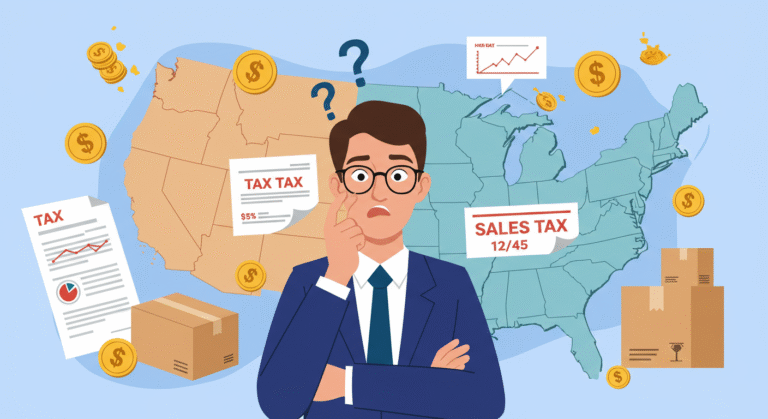
Picture this: It’s Cyber Monday morning, and your e-commerce store just hit record sales. Exciting, right? Then you realize those sales just pushed you over the economic nexus threshold in three new states. Suddenly, you’re legally obligated to collect and remit sales tax in jurisdictions where you weren’t registered yesterday. Sound like a nightmare? It doesn’t have to be.
Holiday e-commerce sales tax compliance can make or break your profitable season. Moreover, the stakes have never been higher. With transaction volumes surging by over 90% during Black Friday and Cyber Monday, one compliance mistake could cost you thousands in penalties and back taxes. This comprehensive guide will walk you through five essential strategies to master holiday e-commerce sales tax before peak season arrives.
Understanding Holiday E-commerce Sales Tax Challenges
Why Peak Season Changes Everything
Have you ever wondered why tax compliance feels more complicated during the holidays? The answer is simple yet significant. During peak shopping season, businesses face a perfect storm of challenges. First, transaction volumes explode. Then, new nexus obligations suddenly appear. Finally, filing deadlines don’t pause just because you’re overwhelmed.
Think of holiday e-commerce sales tax compliance like preparing for a marathon. You wouldn’t show up on race day without training, would you? Similarly, waiting until Black Friday to sort out your tax obligations is a recipe for disaster. Furthermore, the consequences extend beyond immediate penalties.
The holiday season acts as a high-stakes test of tax compliance systems, with sales spikes across channels and jurisdictions making minor compliance errors potentially costly (MyTotalRetail). Consequently, businesses need robust strategies in place well before the rush begins.
The Wayfair Decision Impact
Remember when you only collected sales tax in states where you had a physical store? Those days are long gone. The Supreme Court’s decision in South Dakota v. Wayfair allowed states to require tax collection from businesses without physical presence, provided they meet certain sales thresholds (Ware2go). This changed everything for online retailers.
Now, economic nexus rules mean your holiday sales alone could trigger compliance obligations. Additionally, each state sets its own thresholds. For instance, some require collection at $100,000 in sales, while others use transaction counts. Therefore, tracking becomes exponentially more complex during peak season.
Way #1 – Monitor Your Economic Nexus Thresholds Closely
How Holiday Sales Trigger New Nexus
Here’s the critical insight many sellers miss: If a state has a $100,000 gross sales threshold and you cross that threshold after Black Friday but before Cyber Monday, you technically have an obligation to collect and remit tax on Cyber Monday (Accounting Today). Yes, you read that correctly: your compliance obligations can change overnight.
This scenario plays out constantly during the holiday season. One day you’re comfortably below thresholds in several states. The next morning, a successful promotion pushes you into new territory. As a result, you need real-time monitoring systems that alert you when you’re approaching these critical numbers.
Consider this practical example. Let’s say you’re tracking sales in Colorado, which has a $100,000 threshold. By November 25th, you’ve made $85,000 in sales there. Then Black Friday hits, and you generate another $20,000. Suddenly, you’ve triggered nexus, and every sale afterward requires tax collection. Without proper monitoring, you might not realize this until audit time, when it’s too late.
State-by-State Threshold Variations
Navigating state thresholds feels like juggling while riding a unicycle. Each state has unique requirements. Moreover, these thresholds sometimes change with little notice. Therefore, understanding the landscape is crucial for holiday e-commerce sales tax compliance.
Here’s what you need to know:
- Revenue-based thresholds: Most states use $100,000 in annual sales
- Transaction-based thresholds: Some states count 200 or more separate transactions
- Hybrid models: Certain jurisdictions use “or” conditions (revenue OR transactions)
- Look-back periods: States measure thresholds over different timeframes
Additionally, remember that with over 13,000 sales tax jurisdictions in the United States, your ecommerce store could trigger sales tax in one state or many without realizing it (TaxCloud). This complexity multiplies during peak season when sales velocity accelerates dramatically.
Professional guidance becomes invaluable here. While automation helps track numbers, human expertise interprets regulations and identifies risks before they become problems. That’s why smart businesses combine technology with professional oversight.
Way #2 – Navigate Sales Tax Holidays Strategically
Understanding State-Specific Sales Tax Holidays
Sales tax holidays add another layer of complexity to holiday e-commerce sales tax compliance. These temporary exemption periods sound straightforward, but they’re anything but simple. In fact, sales tax holiday structures vary widely from state to state, with differences in product lists, price caps, and how they treat shipping, handling, layaway sales, and rain check sales.
Let me break this down practically. Imagine you sell clothing and electronics across multiple states. Alabama has a back-to-school sales tax holiday in July. Florida might offer emergency preparedness exemptions. Meanwhile, some states have no holidays at all. Each holiday has specific rules about what qualifies, maximum prices, and whether local taxes apply.
Furthermore, missing a sales tax holiday could mean losing business from customers upset you’re charging tax during a tax-free period. Conversely, incorrectly exempting items that don’t qualify exposes you to liability. Either way, mistakes cost money.
Configuring Your Systems for Tax-Free Periods
So how do you handle this complexity? Start by identifying which sales tax holidays affect your business. Then, configure your systems accordingly. However, here’s the catch; it may be necessary to calibrate point-of-sale systems to the minute to ensure they don’t incorrectly apply sales tax to qualifying transactions or extend exemptions after the holiday ends (BigCommerce).
Think about the logistics involved. Your tax calculation system needs to:
- Know when each holiday starts and ends (sometimes down to the minute)
- Understand which products qualify in each state
- Apply price caps correctly
- Handle split orders with both exempt and taxable items
- Switch back to normal rates immediately after the holiday
This level of precision requires more than just software. It demands careful planning, thorough testing, and often professional verification. Because when your system makes mistakes during high-volume periods, those errors multiply quickly.
Way #3 – Automate Your Tax Calculations Before the Rush
Why Manual Processes Fail During Peak Season
Let’s be honest; manually calculating holiday e-commerce sales tax during peak season is impossible. Consider the math. Tax processing volumes increase by 92% on Black Friday and 83% on Cyber Monday compared to normal days (PYMNTS). Can your team handle nearly double the workload while maintaining accuracy?
Manual processes break down for several reasons. First, human error increases with fatigue. Second, rates and rules change constantly. Third, the sheer volume overwhelms even the largest teams. Additionally, customers expect instant checkout, not delays while someone looks up tax rates.
Here’s a real-world scenario. You’re processing an order from a customer in Colorado who’s buying items that ship from your Texas warehouse to their Denver address. Colorado uses destination-based sourcing. But wait! Does your product qualify for an exemption? Is there a local tax in their specific jurisdiction? What’s the current combined rate? Now multiply this complexity by thousands of orders daily during peak season.
That’s why automation isn’t optional anymore. It’s essential for survival.
Choosing the Right Automation Tools
Not all automation is created equal. Moreover, the stakes are particularly high during holiday sales when system failures prove costly. Therefore, selecting robust, reliable tools becomes critical for holiday e-commerce sales tax compliance.
What should you look for in automation solutions? Consider these essential features:
- Real-time rate updates: Tax rates change frequently; your system must stay current
- Multi-state support: Handle all jurisdictions where you have nexus
- Product taxability rules: Different items have different tax treatments
- Scalability: System must handle surge volumes without slowing down
- Integration capabilities: Works seamlessly with your e-commerce platform
However, here’s the critical point many businesses miss: Cloud-based solutions that integrate with e-commerce platforms reduce manual activity, freeing tax teams to focus on strategic planning while tax determination and filings remain under control. Technology handles the repetitive calculations, but human professionals provide the strategic oversight.
This combination proves particularly powerful during peak season. Automation ensures accuracy at scale. Meanwhile, human experts monitor for anomalies, interpret complex situations, and make judgment calls that software can’t.
For more insights on managing complex compliance scenarios, check out our guide on economic nexus thresholds.
Way #4 – Prepare for Multi-State Filing Requirements
Filing Frequency Changes
Successfully handling holiday e-commerce sales tax extends beyond collection, you must also file and remit correctly. Furthermore, increased sales volumes during peak season can change your filing frequency in some states. This catches many businesses off guard.
Here’s how it works. States assign filing frequencies based on your sales volume, and these frequencies each come with their own due dates that can fluctuate due to holidays, weekends, and other factors (Business News Daily). As your holiday sales push your annual volume higher, some states may shift you from quarterly to monthly filing.
Additionally, due dates don’t pause for the holidays. In fact, many filing deadlines fall in January; right when you’re busiest with holiday returns and new year planning. Therefore, preparation becomes crucial. You need systems in place that track what’s due when, in every state where you’re registered.
Record-Keeping Best Practices
Think of record-keeping as your insurance policy against audits. Meticulous documentation protects your business when questions arise later. Moreover, proper records make filing infinitely easier when deadlines approach.
What records should you maintain for holiday e-commerce sales tax compliance? Here’s your essential checklist:
- Sales data by jurisdiction: Track exactly where customers are located
- Exemption certificates: Document all tax-exempt sales
- Product taxability decisions: Note why items were taxed or exempted
- Filing confirmations: Save proof of every return submitted
- Payment receipts: Keep records of all tax remittances
Additionally, organize records by state and time period. This organization saves countless hours when preparing returns or responding to inquiries. Furthermore, many states require you to retain records for three to seven years. Therefore, implement a systematic archival process.
Professional tax advisors often emphasize that good records prevent problems before they start. When auditors see organized, complete documentation, they’re more likely to move through quickly. Conversely, messy records raise red flags and invite deeper scrutiny.
Way #5 – Conduct a Pre-Holiday Compliance Audit
Essential Checklist Items
Would you launch a major marketing campaign without testing it first? Of course not. Similarly, you shouldn’t enter peak season without auditing your holiday e-commerce sales tax compliance systems. A pre-holiday audit identifies problems while you still have time to fix them.
Your compliance audit should examine these critical areas:
- Nexus status verification: Confirm where you’re registered and where you should be
- Rate accuracy: Ensure your system uses current rates for all jurisdictions
- Product mappings: Verify items are coded correctly for tax purposes
- Sales tax holiday configurations: Test exemptions activate and deactivate properly
- Integration testing: Confirm seamless data flow between systems
Moreover, don’t audit in isolation. Involve your tax advisor in the process. Their expertise catches issues that technical reviews might miss. Additionally, they understand regulatory nuances that could impact your specific situation.
For businesses handling subscription models alongside holiday sales, our article on subscription box sales tax provides additional compliance strategies.
Testing Your Systems Under Load
Here’s a question: Does your tax calculation system work as well at 10,000 transactions per hour as it does at 100? Peak season demands this kind of performance. Therefore, load testing is crucial for holiday e-commerce sales tax compliance.
Retailers must ensure their automation provider has infrastructure and technology to remain operational during holidays, since checkout slowdowns or tax calculation failures during peak times prove costly. This reality makes system testing non-negotiable.
Conduct load testing that simulates actual peak conditions. Run thousands of test transactions. Verify calculations remain accurate under pressure. Check that integrations don’t break when volumes surge. Additionally, test your backup procedures. What happens if your primary system fails on Black Friday?
Professional oversight adds another layer of confidence. Tax experts can review test results, identify potential vulnerabilities, and recommend improvements. This human element catches issues that purely technical testing might overlook.
The Human Element in Holiday E-commerce Sales Tax Compliance
Technology is powerful, but it’s not infallible. That’s especially true when navigating the complex world of holiday e-commerce sales tax. Think about it: algorithms can calculate rates, but can they interpret ambiguous regulations? Software can track thresholds, but can it advise on strategic registration timing?
The answer is no. Successful compliance requires both sophisticated technology and experienced human judgment. Here’s why:
Regulatory interpretation: Tax laws often contain gray areas requiring professional analysis. For instance, when does marketplace facilitator collection exempt you from obligations? How do you handle split fulfillment scenarios? These questions need expert interpretation.
Strategic decision-making: Should you register proactively before reaching nexus? When should you pursue voluntary disclosure? How do you prioritize states for registration? These strategic choices impact your business significantly, and they require human wisdom.
Audit defense: If an auditor comes knocking, software alone won’t protect you. You need professionals who understand audit procedures, can communicate effectively with tax authorities, and know how to negotiate favorable outcomes.
Furthermore, consulting with tax professionals becomes increasingly important as nexus footprints grow, helping businesses navigate complexities and ensure they meet all legal obligations (Taxually). This guidance proves especially valuable during high-stakes periods like the holiday season.
Consider reading our insights on avoiding sales tax audits to understand how professional guidance prevents problems.
Technology and human expertise form a powerful partnership. Automation handles routine tasks at scale. Meanwhile, professionals provide strategic oversight, interpret complex scenarios, and protect your interests. Together, they create a compliance program that actually works when it matters most.
Conclusion
Mastering holiday e-commerce sales tax doesn’t happen by accident. It requires careful planning, robust systems, and professional guidance. The five strategies we’ve covered – monitoring nexus thresholds, navigating tax holidays, automating calculations, preparing for multi-state filing, and conducting pre-holiday audits – form your roadmap to successful peak season compliance. However, implementing these strategies effectively demands both technological tools and human expertise. Don’t let compliance challenges dampen your holiday sales success. Contact My Sales Tax Firm today for a quick, free consultation. Our experienced team will review your specific situation, identify potential risks, and help you implement strategies that protect your business during the busiest season of the year. Let’s make this your most profitable and compliant holiday season yet.