Wondering how often you need to file sales tax returns? You’re not alone. Many business owners assume sales tax filing frequency is uniform nationwide — until they discover one state requires monthly filings while another allows quarterly or even annual.
The truth is, your sales tax filing frequency by state depends entirely on where you have nexus and your specific sales volume or tax liability in that jurisdiction. Getting it wrong can trigger penalties, interest, and compliance headaches, especially for multi-state sellers.
This guide breaks down the main filing frequencies, how states determine them, accelerated payment rules, the real costs of mistakes, and practical steps to stay compliant in 2026.
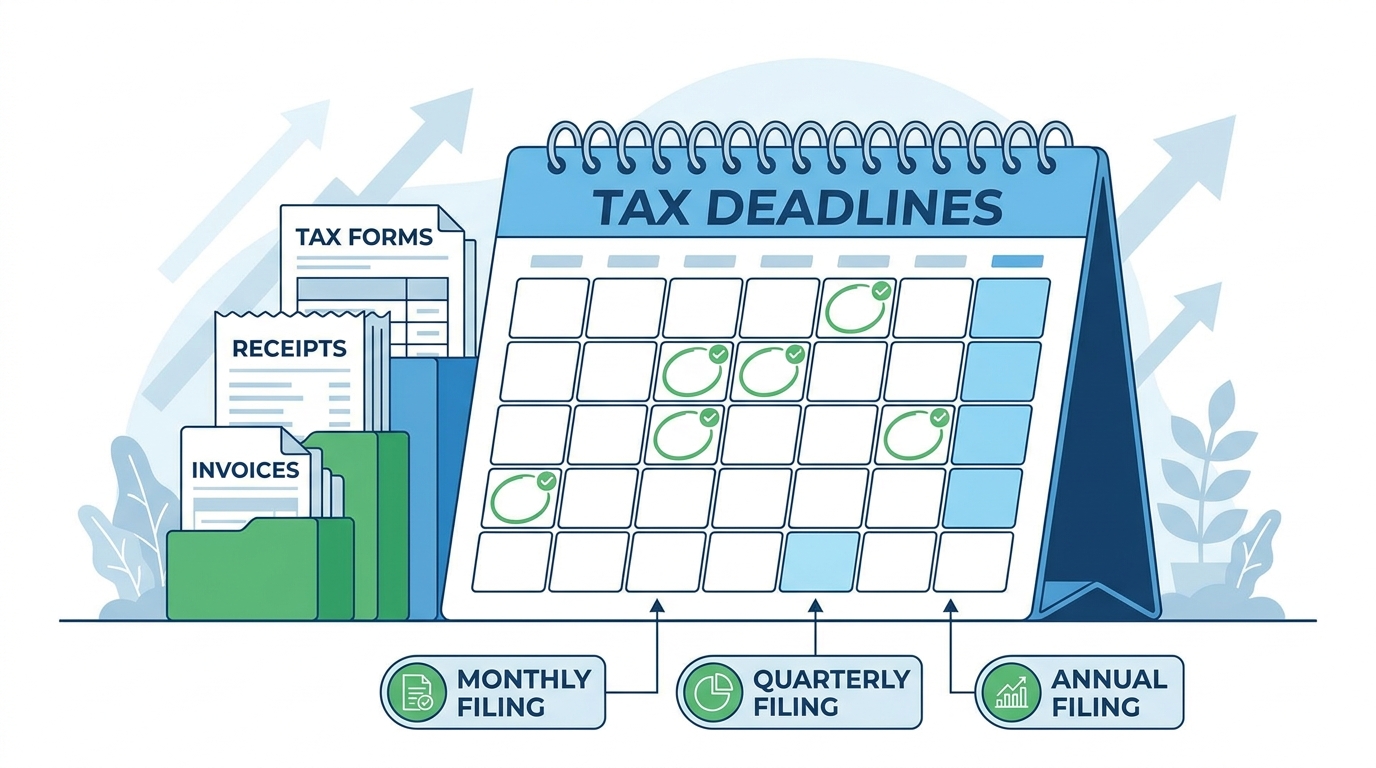
The Three Main Sales Tax Filing Frequencies
States generally assign one of three primary schedules for sales tax returns:
- Monthly Filing — Submit returns every month, typically due by the 20th of the following month.
- Quarterly Filing — File four times a year, covering calendar quarters (e.g., January–March due in April).
- Annual Filing — File once per year, often in January for the prior calendar year.
Some states also use semi-annual or other variations, but monthly, quarterly, and annual cover most businesses.
Monthly Sales Tax Filing: For Higher-Volume Sellers
Monthly filers report and remit sales tax collected each month. This schedule usually applies to businesses with substantial taxable sales or tax liability.
Why monthly? States want faster access to revenue from larger collectors.
Examples of thresholds (vary widely by state):
- Businesses with higher average monthly taxable sales or tax liability (e.g., over certain dollar amounts) get assigned monthly.
- In many states, new registrants start on monthly and may shift later based on actual performance.
If your business is growing, monitor whether you’re approaching monthly thresholds in each state.
Quarterly Sales Tax Filing: The Common Middle Ground
Quarterly filing is the default or “breathing room” option for many mid-sized businesses. You file four returns annually, aligned with calendar quarters.
Most states start new businesses on monthly or quarterly, then adjust based on reported liability. Quarterly provides a balance — less frequent than monthly but more regular than annual.
Thresholds differ dramatically. What qualifies as quarterly in one state might push you to monthly in another.
Annual Sales Tax Filing: Best for Small Liabilities
Annual filing suits businesses with very low sales tax collection in a state. You file once a year and remit the accumulated tax.
This significantly reduces administrative work for small or occasional sellers. However, you must still collect, track, and hold the tax throughout the year.
Annual options often apply when average monthly tax liability stays very low (e.g., under $50–$100 in some states).
Accelerated Payments: When Monthly Isn’t Enough
Some states require accelerated (or prepayment) programs for high-volume sellers. You make estimated payments during the month or quarter, then reconcile on your regular return.
These programs ensure states receive cash flow faster from big collectors.
Common triggers include:
- High annual or monthly tax liability thresholds (e.g., $200,000+ in certain metrics in states like Arkansas or Florida).
- Specific prepayment percentages of prior or current liability.
Missing an accelerated payment deadline can result in penalties — even if your main return is filed on time. The payment schedule often operates separately from the filing schedule.
Examples exist in states like California (monthly prepayments for certain quarterly filers), Pennsylvania, Michigan, and others with varying liability cutoffs.
How States Determine Your Sales Tax Filing Frequency
States don’t let you pick your frequency — they assign it based on objective criteria, usually your prior period’s gross sales, taxable sales, or tax liability.
Key factors states consider:
- Average monthly taxable sales
- Quarterly or annual tax collected
- Estimated liability at registration
Important realities for multi-state businesses:
- Thresholds vary wildly. A liability that triggers monthly filing in one state might allow quarterly or annual in another.
- Your frequency can (and often does) change as your business grows or slows.
- States notify you via mail or online portals, but you’re responsible for compliance regardless of whether you receive the notice.
For instance, some states re-evaluate after your first year or based on consecutive quarters of higher activity. Always verify your assigned frequency in each state’s portal.
Why Filing Frequency Changes and How to Anticipate Them
Filing frequency isn’t fixed. As revenue increases, states may move you from quarterly to monthly. Contractions might allow a downgrade.
Proactive tip: Review your liability quarterly across all states. Watch for patterns that signal upcoming changes in similar jurisdictions.
Failing to update your processes after a change is a common source of penalties.
The Real Cost of Getting Sales Tax Filing Frequency Wrong
Errors compound quickly:
- Late filing penalties — Often 5–10% initially, escalating monthly (sometimes up to 25–30% caps).
- Late payment penalties — Separate charges, frequently a percentage of unpaid tax.
- Interest — Accrues daily or monthly on tax and penalties, with no cap in many cases.
- Combined effect — A modest unpaid balance can grow significantly over months.
You’re liable even without receiving a notice. Ignorance or missed communications (spam, address changes) offers no defense.
Automation helps but doesn’t fully solve frequency monitoring—software needs correct configuration, and threshold decisions often require human oversight.
Best Practices for Managing Sales Tax Filing Frequency Across States
Staying compliant doesn’t have to overwhelm you. Follow these steps:
- Document everything — Maintain a master list of your current filing frequency, due dates, and prepayment requirements in every state.
- Build a compliance calendar — Include filing deadlines, accelerated payments, and buffer reminders (e.g., two weeks early).
- Monitor thresholds proactively — Review sales tax liability quarterly. Anticipate changes before states notify you.
- Keep contact info updated — Ensure every state revenue department has your current address and monitor online dashboards regularly.
- Leverage technology wisely — Use sales tax software for automation, but manually verify frequency settings and updates.
- Know when to seek expert help — Multi-state complexity (different thresholds, prepayments, and change rules) benefits from professional oversight.
Get Professional Help with Multi-State Sales Tax Compliance
Handling varying sales tax filing frequencies by state, plus accelerated payments and shifting thresholds, is complex — especially as your business scales.
At My Sales Tax Firm, we specialize in monitoring frequencies, tracking changes, managing deadlines, and building scalable compliance strategies. We help businesses avoid surprises and focus on growth instead of tax administration.
Contact us today for a free consultation. We’ll review your current setup, spot risks, and create a plan tailored to your operations.
Don’t let sales tax filing frequency slow you down. Reach out now to ensure you’re compliant and penalty-free in 2026 and beyond.
Key Takeaway: Sales tax filing frequency by state is determined by your activity levels, not preference. Stay informed, monitor changes, and don’t hesitate to bring in experts when multi-state rules become too intricate.
(Always confirm current thresholds and rules directly with each state’s Department of Revenue, as requirements can update.)